

Every Saysh shoe is built on a women’s last.
She isn’t a scaled-down version of anyone. Neither is anything we put on her feet.
What a last is
A last is the foot-shaped form a shoe is built around. The inside of the shoe takes on the last’s shape.
- The last sets the shoe’s length and width, and how much room her toes and instep get.
- The upper is pulled and formed over the last, so the shoe takes on its shape.
- The last decides how the heel is cupped and how far the toe curves up.
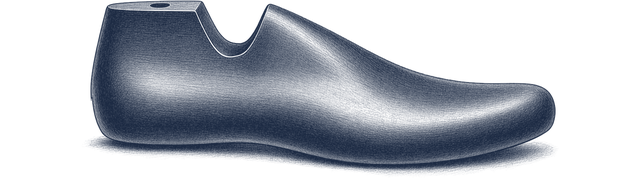
From a generic last to a Saysh last
Slide to see what we changed when we started with her.

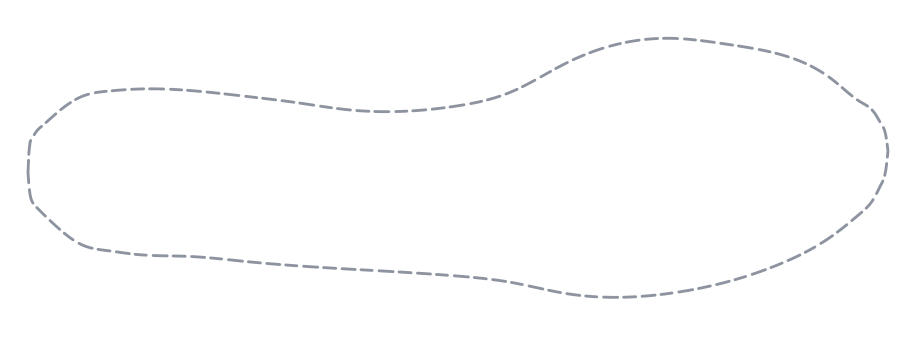


Start · generic last
Where we started: the shape before any change.
Wider forefoot
More room across the ball of her foot.
Narrower heel
A closer hold at the back of her heel.
Illustration of our design changes, not to scale.
I’ve helped some of the largest shoe companies in the world design shoes. I’ve raced in those shoes on the world’s biggest stages. I never knew those shoes weren’t actually made for my body, simply because I’m a woman. We’re changing that—that’s why Saysh exists.
Myth vs fact
MythWomen’s feet are just smaller men’s feet.
Even at the same length, women’s feet are shaped differently, at the arch, the outer side, the big toe and the ball of the foot.
Wunderlich RE, Cavanagh PR. Med Sci Sports Exerc, 2001.
MythWomen have lower arches.
Arch height is about the same. Women’s arches tend to be more flexible.
Zifchock RA et al. Foot Ankle Int, 2006.
MythWomen and men run the same way.
In a study of recreational runners, women moved differently at the hip and knee than men.
Ferber R et al. Clin Biomech, 2003.
MythYour feet go back to normal after pregnancy.
Pregnancy can change your feet in ways that last well after birth, especially the first time.
It’s why our maternity promise covers a new size, free.
Segal NA et al., Am J Phys Med Rehabil, 2013.
